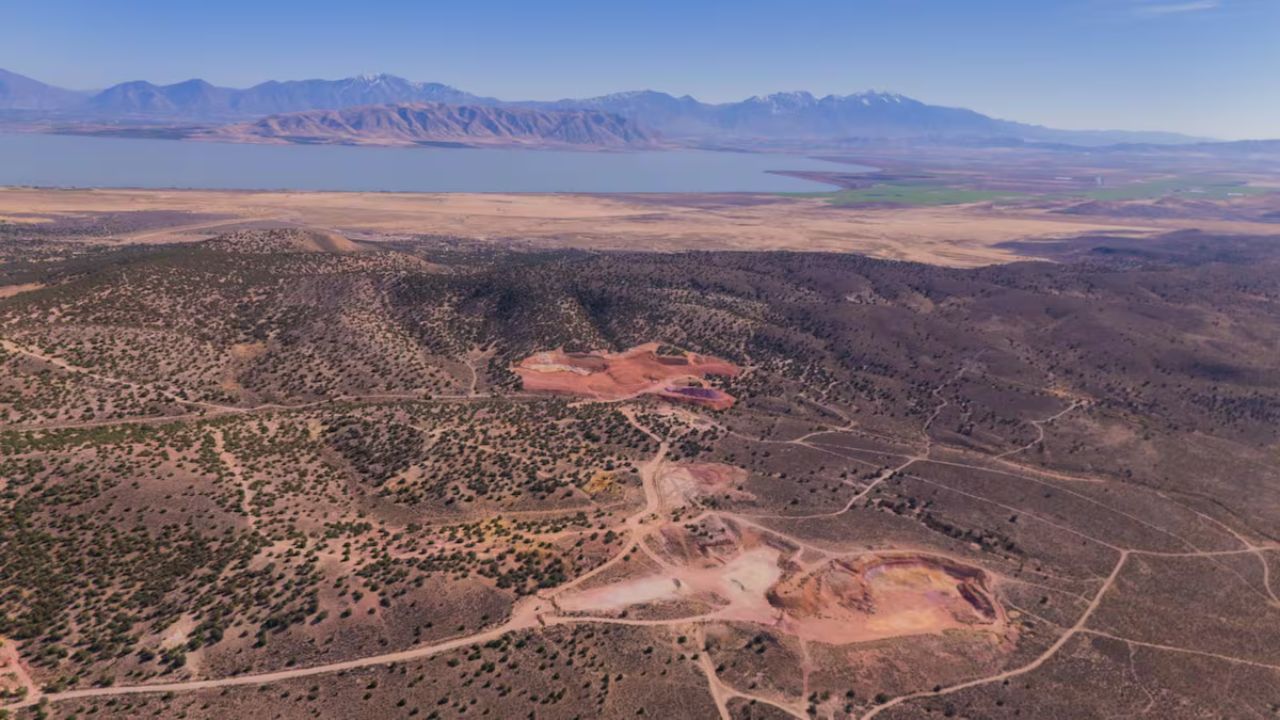
What started as standard exploration work at a nanosilicon mining site in Utah has rapidly evolved into what Ionic Mineral Technologies calls a potentially landmark discovery for U.S. critical mineral exploration. The company, best known for producing nanosilicon used in lithium-ion batteries for electric vehicles and energy storage, announced that testing at its leased Silicon Ridge property revealed unexpectedly high concentrations of valuable minerals.
Independent Tests Confirm Rich Mineral Mix
According to Ionic, third-party laboratory analysis confirmed elevated levels of 16 different minerals. These include lithium, alumina, germanium, rubidium, cesium, vanadium, niobium, and scandium—all of which are considered vital for semiconductors, defense systems, clean-energy technologies, and advanced electronics.
This broad mineral spectrum places the Utah site among the most promising critical minerals deposits in the United States, especially as demand accelerates for domestic supply.
Geological Similarities to China’s Rare Earth Deposits
Ionic explained that the deposit is a halloysite-hosted ion-adsorption clay, a geological formation strikingly similar to the soil structures that support China’s dominance in rare earth production. China currently supplies about 90% of the global rare earth market, raising long-standing concerns over supply chain vulnerability.
These similarities suggest the Utah discovery could hold strategic importance for reshaping U.S. rare earth and critical minerals independence.
National Security and Government Interest
Critical mineral development has increasingly been framed as a national security priority. Under the Trump administration, the U.S. classified critical minerals as essential to defense and economic stability. Recently, the U.S. and Australia jointly committed over $3 billion toward mineral exploration and extraction initiatives.
Ionic confirmed that company representatives have met with federal officials, who showed strong interest in the scale and strategic value of the Silicon Ridge project.
Size, Infrastructure, and Expansion Potential
Founder and CEO Andre Zeitoun stated that early drilling results indicate the deposit extends far beyond initial expectations. Exploration to date has covered over 600 acres, reaching depths of roughly 100 feet. However, the total permitted mining area spans around 8,000 acres, already equipped with roads, utilities, and water access.
Processing is expected to occur at Ionic’s Provo, Utah facility, a factor that could significantly speed up commercialization.
“We know this is a sizable deposit, and we know that’s just scratching the surface,” Zeitoun said in an interview with The Wall Street Journal.
High-Value Applications Across Industries
The minerals identified have wide-ranging uses:
- Lithium underpins electric vehicle and grid-scale battery manufacturing
- Scandium strengthens aluminum alloys used in aircraft and fuel cells
- Rubidium and cesium are essential for atomic clocks, quantum sensors, and telecommunications
- Germanium and niobium play roles in semiconductors and aerospace components
Zeitoun also noted that the deposit consists of soft clay from an ancient dried lake bed, potentially allowing for surface-level extraction, which may reduce mining complexity.
Challenges Still Remain
Despite its promise, experts caution that ion-adsorption clay deposits can be difficult to process. Barbara Arnold, professor of mining engineering at Pennsylvania State University, explained that valuable elements are often tightly bound within clay minerals. This can increase energy requirements and extraction costs, making efficient processing a key challenge.
Broader Push for Domestic Minerals
The U.S. Department of the Interior recently expanded its official critical minerals list, adding copper and uranium. At a Washington, D.C. conference, Interior Secretary Doug Burgum emphasized that the U.S. holds vast, underdeveloped mineral resources on public lands and urged more strategic development to support energy independence and industrial resilience.
A Shift in Ionic’s Role
For Ionic Mineral Technologies, the Utah find could mark a dramatic transformation—from a nanosilicon producer to a central figure in America’s critical minerals strategy. As Zeitoun put it:
“This is a district, not a mine.”