Heidi Barr. Hoi “Holly” Xuan. Anjala Evans. Jose Hernandez.
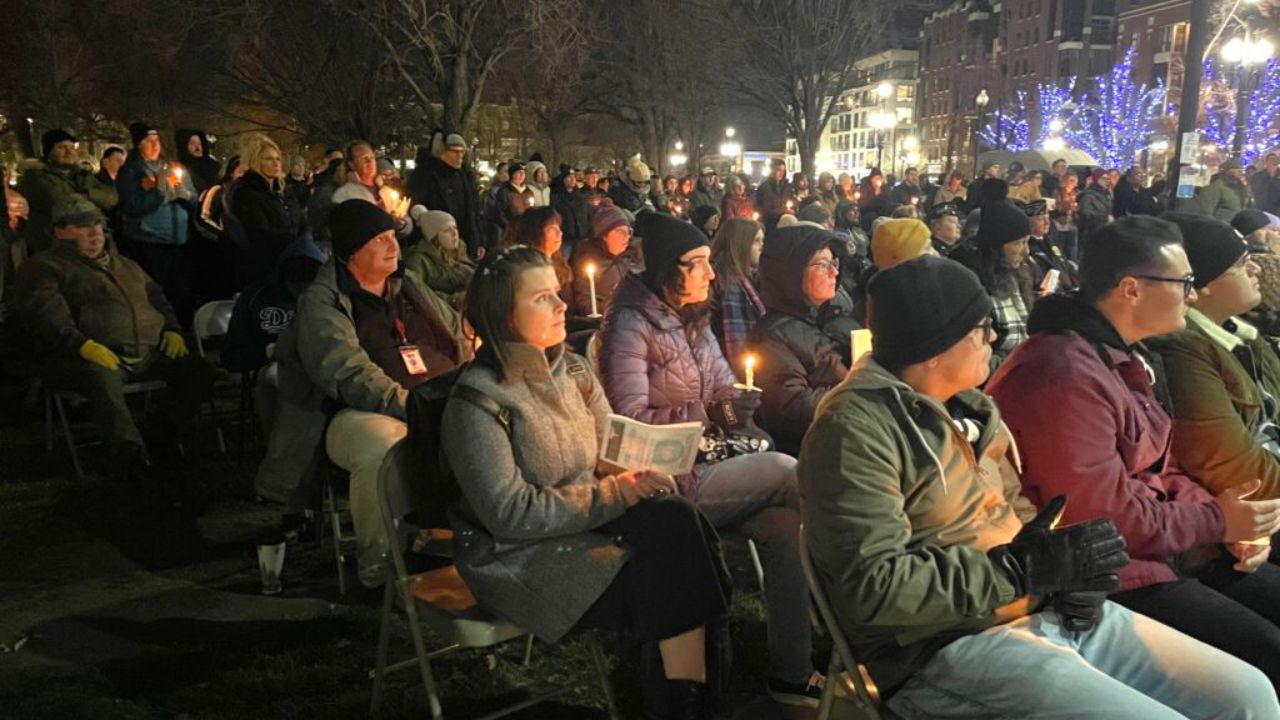
Each name carried weight on Thursday night as it was spoken aloud before a quiet, candle-lit gathering at Pioneer Park in Salt Lake City.
As the crowd stood in silence, Herbert Elliot, co-chair of the consumer advisory board for the Fourth Street Clinic — a healthcare provider serving people experiencing homelessness in Salt Lake City — marked each name by dropping a small stone into a clear glass jar. With every name, the sound of stone touching glass echoed softly through the park.
By the end of the reading, nearly 80 stones filled the jar, representing the number of known individuals who died in 2025 while experiencing homelessness or after having been homeless. Organizers emphasized that the real number is likely higher.
This annual vigil is a long-standing tradition in Utah, created to honor lives lost within the homeless community and to remember people who too often pass away without recognition.
A Personal Moment of Loss
When the name James Owen Dennis was read, a man wearing a hood quietly whispered, “Love you, James.”
That man was Darien Willardson, an outreach leader with the Rescue Mission, a faith-based nonprofit serving people without housing in Salt Lake City.
The single candle in Willardson’s hands slowly burned down as the ceremony continued, melting to the base of its wick by the final name.
After the vigil, Willardson shared that he personally knew two people on the list: James Dennis and another man named Rodney, whose last name was unknown.
Dennis had previously completed the Rescue Mission’s recovery program. Later, after relocating to care for his father, he was diagnosed with cancer. He passed away just two weeks before the vigil.
“He loved attending Bible study,” Willardson recalled. “He never judged or preached. He would simply read scripture and reflect on it quietly.”
Rodney’s Final Days Under the Bridge
Willardson also spoke about Rodney, whom he often met beneath a bridge near the Jordan River Trail. Despite repeated encouragement, Rodney chose not to enter shelter services.
“That bridge was his home,” Willardson said. “He wanted to live out his days there.”
Respecting Rodney’s choice, Willardson continued checking on him and bringing supplies to make his situation safer and more comfortable.
One day, Rodney was gone.
When Willardson returned in October, nearby campers told him that Rodney’s body had been removed the previous week. The exact cause of death was unknown — possibly exposure, illness, or overdose.
“I sometimes wish I could have pulled him out of there,” Willardson admitted. “But I know I did everything I could. I can’t change hearts — I can only show love.”
Honoring the Dead While Calling for Change
The vigil blended music, prayer, and reflection, but it was also a platform for urgent calls to action.
Former Utah Senate President Wayne Niederhauser, who recently retired as the state’s homeless coordinator, addressed the crowd with emotion. He described resource shortages as one of the biggest challenges in addressing homelessness.
“There’s not enough treatment, housing, or support,” he said. “And when resources are scarce, our most vulnerable people suffer the most.”
While acknowledging progress in recent years through increased funding for housing, shelters, and services, Niederhauser praised frontline workers.
“They may not be getting rich financially,” he said, “but they’re rich in humanity. Helping others is a reward beyond money.”
From the Streets to Service
Another speaker, Jarod Beardon, shared his own journey from homelessness to working with The INN Between, an organization providing end-of-life care for people experiencing homelessness.
Beardon admitted he hesitated to speak because his experiences still affect him deeply.
“I remember walking all night just to find a safe place to sleep,” he said. “I had a phone — but no one I could call.”
He spoke about exhaustion, addiction, and the painful looks he received from passersby.
“For the first time in my life,” he said, “I felt less than human.”
The names read aloud that night, he explained, felt personal.
“They’re not just names to me. In many ways, they are me.”
Through his work, Beardon has learned that trauma connects everyone, regardless of background or income. Some of those honored died alone on the streets, while others spent their final days at The INN Between, resting in a bed and surrounded by compassion.
“Everyone deserves dignity,” he said. “Everyone.”
A Call for Compassion and Support
More than 100 people attended the vigil, but speakers stressed that attendance alone is not enough.
“We’re making progress,” Beardon said, “but it’s only a small dent.”
He urged the community to offer more support, more donations, and more basic supplies like clothing, food, and socks. Above all, he emphasized the need for empathy.
“The most important thing,” he said, “is that we stop judging. Homeless people are people. They deserve compassion.”