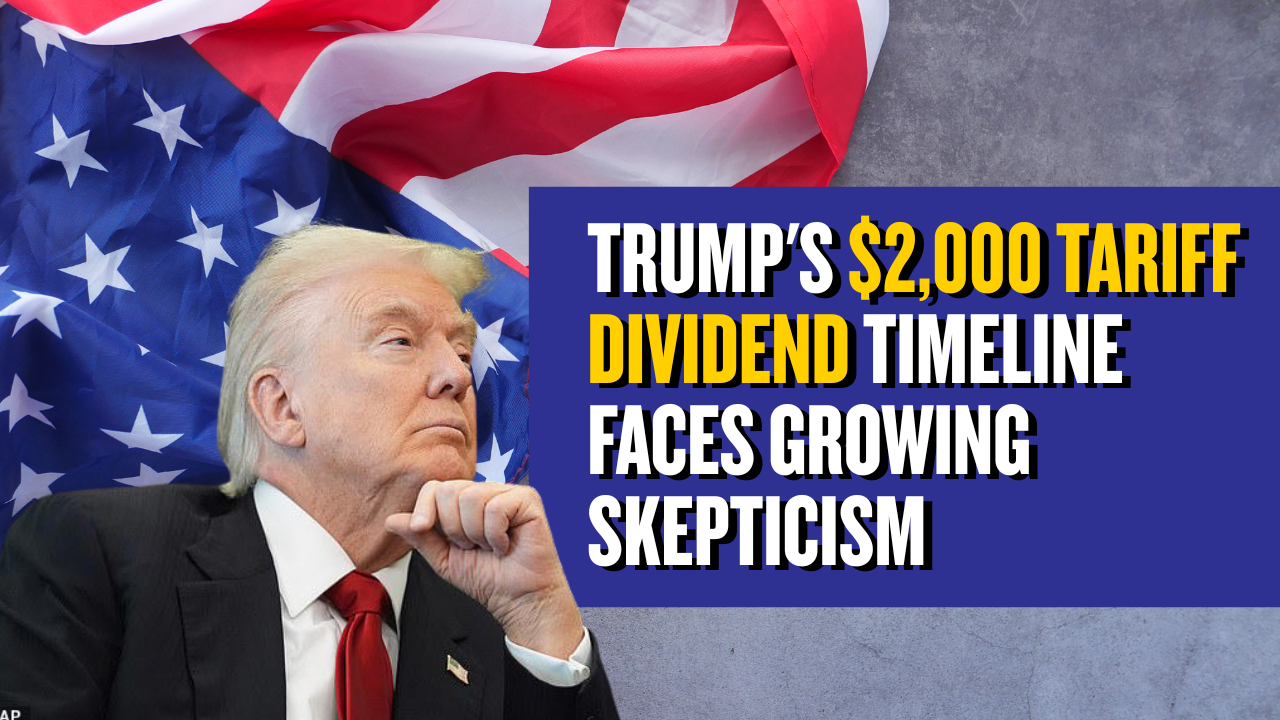
WASHINGTON — President Donald Trump has provided new details about his proposed tariff dividend program, suggesting Americans could receive $2,000 checks by mid-2026, though significant obstacles remain before any payments materialize.
Mid-2026 Target Date Announced
During an Oval Office appearance with reporters on Monday, November 17, Trump indicated that individuals with moderate incomes might expect dividend payments “probably in the middle of next year.” The President outlined his vision for distributing tariff revenue directly to middle-class Americans, though the timeline and feasibility remain uncertain.
“We’re going to be issuing dividends later on, somewhere prior to, probably in the middle of next year, a little bit later than that. Thousands of dollars for individuals of moderate income, middle income,” Trump stated, according to reports.
The dividend concept first emerged in July when Trump suggested tariff revenue could fund rebates, though he emphasized the primary goal was debt reduction. The president has referenced these potential payments repeatedly since then, including a November 10 post on Truth Social specifying $2,000 amounts for low and middle-income citizens.
Treasury Secretary Expresses Caution
Treasury Secretary Scott Bessent offered a more measured assessment during a November 16 appearance on Fox News’ “Sunday Morning Futures.” When questioned about the dividend plan, Bessent told host Maria Bartiromo that “we will see” whether the program actually happens, noting that implementation would “need legislation for that.”
Bessent described the potential recipients as “working families” but stopped short of confirming the checks “could go out,” highlighting the uncertain path forward for the proposal.
Revenue Gap Presents Major Challenge
Current tariff collections fall dramatically short of funding requirements for a nationwide dividend program. The Committee for a Responsible Federal Budget, a nonpartisan fiscal policy organization, estimates that distributing $2,000 checks would require approximately $600 billion in revenue. However, tariffs have generated only about $100 billion to date.
Monthly tariff revenue averages around $30 billion, according to Scott Lincicome, vice president of general economics at the Cato Institute, a libertarian think tank. This figure remains nowhere near the levels needed to support the proposed rebate program.
Economic Policy Concerns
Lincicome criticized both the mathematics and policy implications of the tariff dividend plan in a statement to USA TODAY. He noted that the proposal essentially highlights how American consumers ultimately pay for tariffs through higher prices on imported goods.
“Giving Americans their own money back is inefficient redistribution, and new, debt-financed stimulus checks could be inflationary,” Lincicome wrote on X on November 17. He suggested that eliminating or reducing tariffs would be more economically sound than attempting rebate distributions.
Long-Term Revenue Projections
The Congressional Budget Office has projected that tariffs could generate $3.3 trillion over ten years, potentially providing $4 trillion in total government value when accounting for accelerated debt payments and reduced interest obligations. However, these long-term estimates don’t address the immediate funding shortfall for 2026 dividend payments.
Market Predictions Show Doubt
Prediction markets reflect substantial skepticism about the dividend program’s implementation. Polymarket activity suggests only a 4% probability that tariffs will generate more than $250 billion in 2025, down sharply from 35% in April. Trading volume on this question has exceeded $934,690.
Similar patterns appear on Kalshi, where users have wagered over $1.2 million on tariff-related outcomes. The platform shows just 24% likelihood that the Supreme Court will uphold Trump’s tariff authority, down from 58% when trading began in early September.
Supreme Court Challenge Looms
Legal challenges pose another potential obstacle to the dividend plan. During November 5 oral arguments, a majority of Supreme Court justices expressed skepticism about the Trump administration’s claim that it can impose sweeping tariffs without congressional authorization.
If the court rules against the administration’s tariff authority, the entire revenue model underlying the dividend proposal would collapse, regardless of congressional willingness to authorize the payments.
Financial Planning Implications
Financial advisors would likely caution against adjusting spending plans based on anticipated dividend checks. With legislative approval required, revenue targets unmet, and legal challenges pending, counting on these payments carries considerable risk.
The combination of political, financial, and legal uncertainties means Americans should view the $2,000 dividend as a proposal rather than a commitment. Whether Trump’s timeline proves realistic depends on resolving multiple significant hurdles over the coming months.