
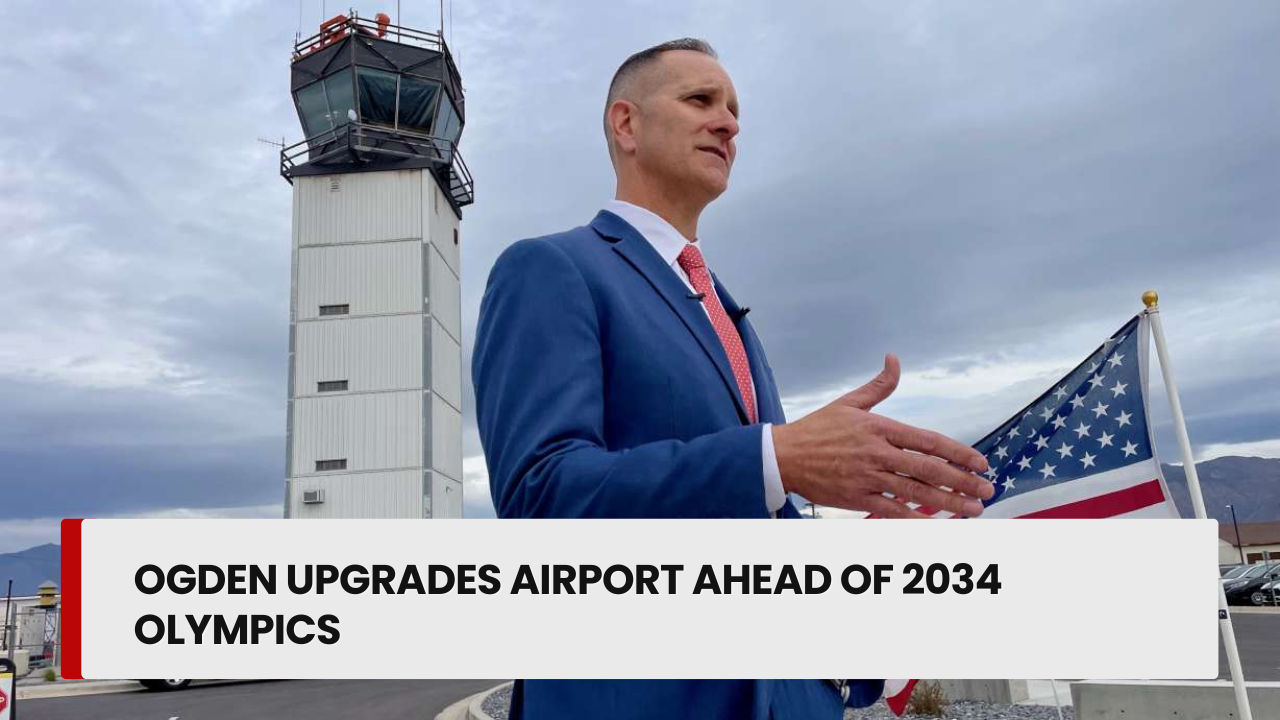
Ogden city leaders have officially revealed a major upgrade to the Ogden-Hinckley Airport terminal — a renovation designed to improve passenger experience, attract new commercial airlines and prepare the region for the heavy travel demand expected during the 2034 Winter Olympics.
The refreshed terminal now features a redesigned ticketing area, an indoor baggage-claim section and improved parking and roadway access, marking one of the most significant enhancements the city-owned airport has seen in years.
Airport Director Brian Condie said the improvements finally bring the facility up to standards airlines and travelers expect. “That’s what we were lacking,” Condie noted during Friday’s unveiling ceremony attended by Ogden Mayor Ben Nadolski, U.S. Rep. Blake Moore and Weber County officials.
The project cost $4.4 million, with most funding coming from federal sources, including programs under the U.S. Department of Transportation, which routinely supports airport development nationwide.
City officials say this is only phase one. A new air traffic control tower is planned but several years away, and the long-term 20-year airport plan includes the addition of up to six jetways to accommodate future commercial growth.
Leaders hope these upgrades make Ogden more attractive to prospective airlines, especially as Utah prepares to host massive global crowds during the 2034 Olympics. Currently, Breeze Airways is the only carrier serving the airport, offering two weekly flights to Orange County.
One of the most forward-looking elements of the plan involves the introduction of electric vertical takeoff and landing aircraft (eVTOLs) — next-generation electric craft designed to shuttle Olympic spectators quickly from Ogden-Hinckley to Snowbasin Resort, a primary venue for several skiing events. Condie said the airport hopes to secure 30 to 40 eVTOLs as a way to reduce roadway congestion and move visitors efficiently during the Games.
A cargo apron is already under construction to support these aircraft, and the city has applied for a state grant to install the high-capacity electrical systems required for charging. Mayor Nadolski said the technology may seem futuristic, but he believes Ogden is uniquely positioned to be a major player in the emerging advanced air mobility market.
Nadolski also emphasized the airport’s expanding role as Utah prepares for global attention: “Salt Lake City International can’t handle all the traffic. This airfield will be essential for the Olympics — we welcome the world.”
Rep. Moore echoed the sentiment, pointing to the region’s rapid growth. “This is part of preparing for what we all know is coming,” he said.
The airport had previously faced criticism following a 2024 audit that cited poor planning and 17 consecutive years of financial losses. Condie said the new investments and long-range planning directly address those concerns and put the airport on a more stable, strategic path forward.
With a modernized terminal, plans for eVTOL operations and the ambition to welcome new carriers, Ogden-Hinckley Airport is positioning itself as a critical transportation hub—not just for northern Utah residents, but for the world stage in 2034.