
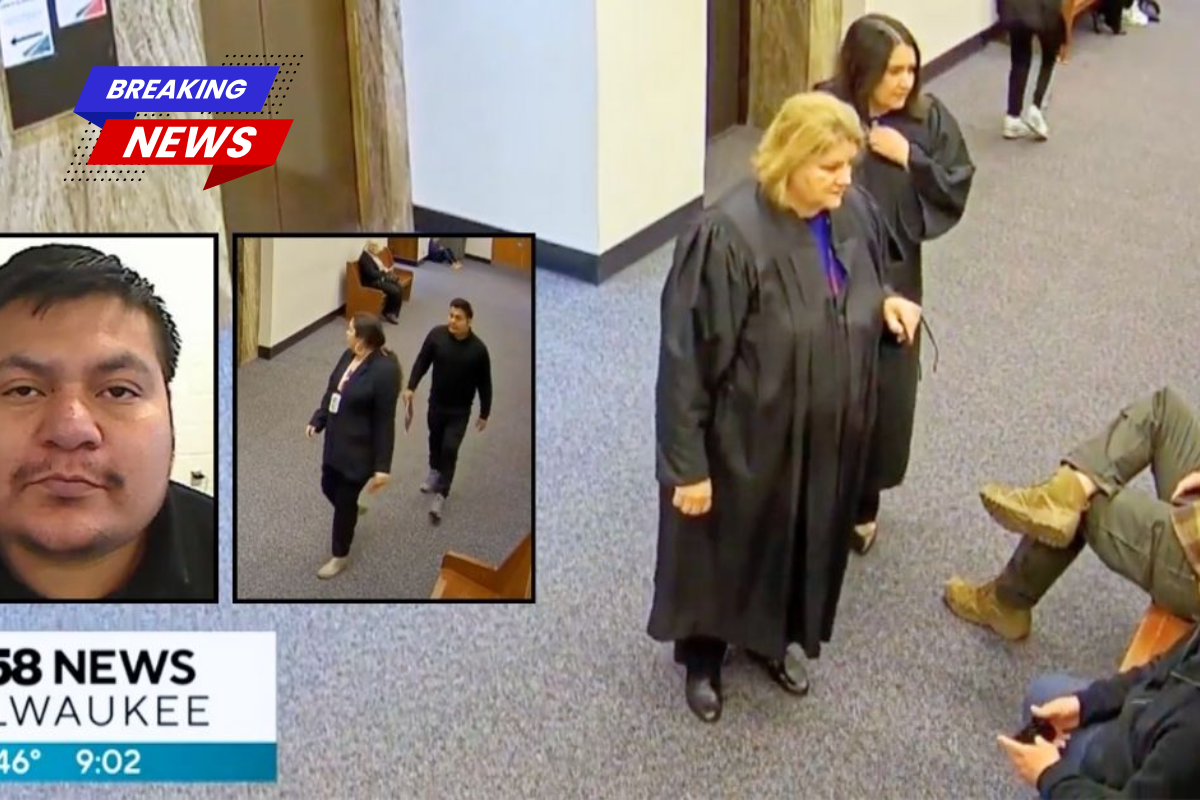
Former Milwaukee County Circuit Judge Hannah Dugan is asking a federal court to overturn her felony conviction or grant a new trial, arguing that Immigration and Customs Enforcement (ICE) agents acted unlawfully when they attempted to arrest an undocumented immigrant inside her courthouse.
In a Jan. 30 motion, Dugan’s attorneys contend that ICE violated a longstanding common-law privilege that bars civil arrests — including immigration arrests based on administrative warrants — from taking place in courthouses. Because the arrest attempt itself was unlawful, they argue, Dugan’s conviction “cannot stand as a matter of law.”
Background of the Case
Dugan, 66, was convicted in December of one felony count of obstructing or impeding a proceeding before a federal agency. A jury acquitted her of a separate misdemeanor charge of concealing an individual to prevent arrest.
The charges stem from an April 18, 2025 incident involving Eduardo Flores-Ruiz, an undocumented immigrant who appeared in Dugan’s courtroom in connection with a domestic abuse case. ICE agents were present in the Milwaukee County courthouse that day seeking to arrest Flores-Ruiz following his hearing.
Allegations Against Dugan
Federal prosecutors alleged that Dugan impeded ICE agents by falsely telling them they needed a judicial warrant to take Flores-Ruiz into custody and by allowing him to exit the courtroom through a jury door rather than a public hallway.
Flores-Ruiz was not arrested that day but was later detained by federal authorities and deported in November.
Defense Cites “Common-Law Privilege” Against Courthouse Arrests
Dugan’s legal team, led by former U.S. Attorney Steve Biskupic, argues that ICE had no lawful authority to execute an administrative immigration warrant inside a state courthouse against a party appearing for a scheduled court proceeding.
The motion cites multiple federal district court decisions issued since 2020, including rulings from California and New York, recognizing a common-law privilege that protects parties and witnesses from civil arrest while entering, attending, or leaving court proceedings.
Dugan’s lawyers also point to a 2020 ruling from the Southern District of California that temporarily barred ICE from making civil arrests in courthouses, rejecting the government’s argument that the privilege does not apply to federal agents.
“Since 1894, Wisconsin has joined many other courts — including the U.S. Supreme Court — in recognizing a common-law privilege against civil arrests in courthouses,” the motion states. “This privilege specifically precludes ICE courthouse arrests for deportation or removal.”
Jury Instruction Dispute
The defense also argues that jurors were improperly instructed during deliberations.
According to post-trial interviews, jurors asked whether Dugan needed to know who ICE agents were seeking in order to convict her. Jurors said the trial judge instructed them that such knowledge was required for the misdemeanor charge but not for the felony obstruction count.
Dugan’s attorneys argue that this distinction improperly broadened the indictment and deprived jurors of guidance on Dugan’s asserted legal authority as a judge.
“The court’s response constructively amended the indictment,” the motion claims.
At least one juror later told the Milwaukee Journal Sentinel that, had the instructions been different, the jury likely would have acquitted Dugan.
Dugan Resigns From the Bench
Dugan stepped down from the Milwaukee County Circuit Court bench last month, formally resigning to continue fighting her conviction.
In a letter to Wisconsin Gov. Tony Evers, she described the prosecution as unprecedented and warned that it posed a threat to judicial independence.
“I am the subject of unprecedented federal legal proceedings,” Dugan wrote. “I am pursuing this fight for myself and for our independent judiciary.”
Potential Sentencing and Next Steps
Although the felony obstruction charge carries a potential sentence of up to five years in federal prison, a prison term is widely considered unlikely given Dugan’s lack of a criminal record and the circumstances of the case.
A federal judge has not yet ruled on Dugan’s motion for a new trial or to set aside the jury’s verdict.