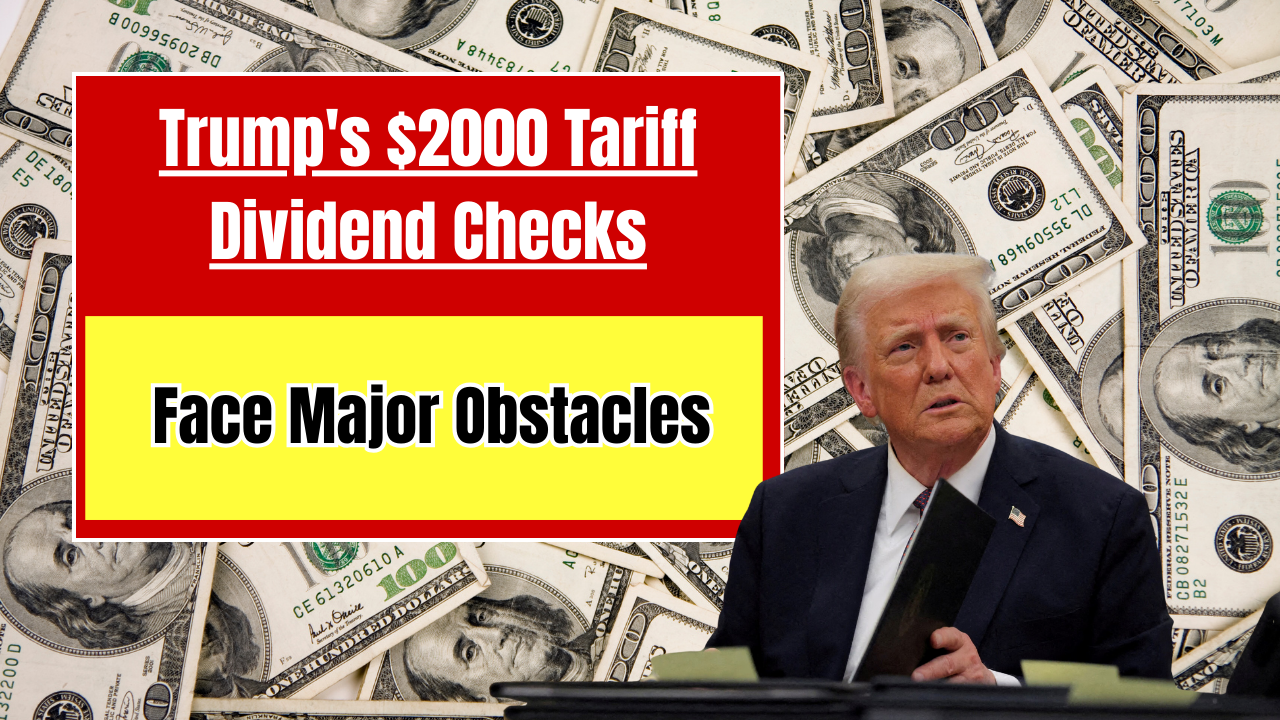
President Donald Trump has renewed his promise to send Americans direct payments of at least $2,000 through what he calls “tariff dividend” checks, but significant financial, legal, and legislative hurdles stand between the proposal and actual implementation.
The Tariff Dividend Promise
Trump announced plans to distribute $2,000 payments to Americans using revenue collected from tariffs on imported goods. Speaking to reporters in the Oval Office in November 2025, the president suggested these checks would arrive by mid-2026, targeting individuals with moderate and middle incomes while excluding high earners.
The proposal represents Trump’s latest attempt to provide direct financial relief to American households, following similar unfulfilled promises earlier in 2025 regarding “DOGE dividends” from Department of Government Efficiency savings that never materialized.
Treasury Secretary Scott Bessent indicated the dividends could take various forms, including direct payments, temporary tax relief, or tax cuts already enacted through the One Big Beautiful Bill Act, such as eliminating taxes on tips, overtime pay, and Social Security benefits.
Revenue Reality Check
The fundamental challenge facing Trump’s proposal centers on basic arithmetic. According to Treasury Department data, the United States raised approximately $195 billion in customs duties through fiscal year 2025, a substantial sum that nonetheless falls short of what would be needed to fund the proposed payments.
Independent calculations suggest that sending $2,000 checks only to adults excluding the highest earners would cost at least $300 billion. If the program expanded to include children, similar to COVID-era stimulus checks, the Committee for a Responsible Federal Budget estimates costs could reach $600 billion.
Tax policy analysts note that tariff revenue’s impact on federal budgets is reduced because each dollar of tariff revenue offsets approximately 24 cents in income and payroll tax collections. This means the actual net revenue from tariffs is significantly less than the gross amount collected.
The Yale Budget Lab projects tariffs could generate around $2.5 trillion over the next decade, while the Congressional Budget Office forecasts $3.3 trillion in revenue between 2025 and 2035. However, these projections depend on maintaining current tariff policies without legal challenges or modifications.
Competing Budget Priorities
The tariff revenue Trump plans to distribute is already committed to other purposes. In August 2025, Treasury Secretary Bessent told CNBC the administration was laser-focused on paying down the national debt before considering dividend payments.
The administration also announced a $12 billion agricultural aid package in December 2025, funded through tariff revenues, to compensate farmers affected by trade disputes. These competing claims on the same revenue stream create fundamental conflicts in budget planning.
Trump himself has stated on multiple occasions that tariff revenue would be used to reduce the $37 trillion national debt, making the same funds unavailable for direct payments to households.
Congressional Approval Required
Treasury Secretary Bessent acknowledged on Fox News that the administration needs legislation to distribute any tariff dividend. This requirement represents a major obstacle, as Congress must pass a bill authorizing the payments before any checks could be issued.
Republican Senator Josh Hawley introduced the American Worker Rebate Act in July proposing stimulus checks, but the idea has not gained traction in either chamber of Congress. No formal legislation currently exists to authorize Trump’s proposed $2,000 payments.
The political dynamics surrounding such legislation remain uncertain. While direct payments to constituents might seem appealing during an election year, concerns about inflation, deficit spending, and competing budget priorities could limit congressional appetite for the proposal.
Supreme Court Challenge
Perhaps the most significant threat to the tariff dividend plan comes from ongoing legal challenges to the tariffs themselves. Multiple cases before the U.S. Supreme Court question whether the administration exceeded its executive authority by imposing tariffs using the International Emergency Economic Powers Act without explicit congressional approval.
A ruling against the government could invalidate some or all of the tariffs that generated the revenue Trump plans to distribute. If tariffs are ruled unlawful, the government would likely need to refund billions already collected from importing companies, eliminating any surplus for dividend payments.
When asked about potential adverse Supreme Court rulings, Bessent expressed confidence but acknowledged the complexity, questioning how refunds would be distributed to consumers if tariffs were overturned.
Income Thresholds and Eligibility
Specific details about who would qualify for tariff dividend checks remain unclear. Bessent has described eligible recipients as working families, but the administration has not defined precise income thresholds.
Bessent suggested a possible income cap excluding households earning over $100,000 annually, though he emphasized all details remain under discussion. During the COVID-19 pandemic, stimulus checks went to individuals earning up to $75,000 and married couples earning up to $150,000, with partial payments extending to higher income levels.
Tax Foundation analysis indicates that excluding those with incomes over $100,000 would still leave approximately 150 million adults potentially eligible for payments.
Inflation Concerns
Economists warn that distributing large stimulus checks could risk reigniting inflation, as past stimulus payments have done. This concern directly contradicts the administration’s messaging that inflation is under control and prices will decline.
The timing of potential payments in mid-2026, just before midterm elections, raises additional questions about economic motivations versus political calculations.
Research from the National Bureau of Economic Research found that 40 percent of the 2020 CARES Act stimulus payments were spent, 30 percent used to pay down debt, and 30 percent saved. Subsequent stimulus rounds saw similar patterns, with most funds either spent or used for debt reduction rather than saved.
Bessent has suggested the administration hopes Americans would deposit tariff dividends into Trump accounts, new investment accounts for children created under recent legislation, rather than spending them. However, economic research suggests families receiving unexpected payments typically use them for immediate needs or debt reduction.
Alternative Tax Relief Proposals
Rather than direct checks, some administration officials have suggested the tariff dividend concept could be fulfilled through tax cuts already enacted. The One Big Beautiful Bill Act eliminated federal taxes on tips, overtime pay, and made auto loan interest deductible.
These tax provisions reduce federal revenue but don’t require the same administrative infrastructure as mailing checks to millions of households. However, they also don’t provide the immediate, tangible benefit that a $2,000 check would deliver.
Historical Context and Precedent
During the COVID-19 pandemic, Congress passed three rounds of stimulus checks, two signed by Trump during his first term, totaling more than 476 million payments worth $814 billion to American households.
Those payments required bipartisan congressional approval and were justified by the extraordinary economic disruption caused by the pandemic. The current proposal lacks a similar crisis justification and would need to overcome skepticism about deficit spending during relatively stable economic conditions.
Trump’s proposal earlier in 2025 to distribute DOGE savings never materialized into actual payments, creating skepticism about whether tariff dividends will fare differently.
State of Play
As of December 2025, the tariff dividend proposal remains in limbo. Trump providing a timeline of mid-2026 represents progress beyond merely suggesting the idea, but substantial obstacles remain before any checks could reach American households.
The proposal requires congressional legislation that doesn’t currently exist, depends on tariff revenue already committed to other purposes, and could be eliminated entirely by adverse Supreme Court rulings. Additionally, the basic mathematics of funding $300-600 billion in payments from $195-217 billion in annual tariff revenue presents an insurmountable gap.
Expert Analysis
Fiscal policy experts have expressed skepticism about the proposal’s viability. Erica York, vice president of federal tax policy at the Tax Foundation, noted that the rebate scheme would increase the national debt given the gap between revenue and costs.
The Committee for a Responsible Federal Budget and other nonpartisan fiscal watchdog organizations have questioned whether the administration can simultaneously use tariff revenue to pay down debt, fund agricultural assistance, and distribute hundreds of billions in direct payments.
What Comes Next
The immediate focus shifts to Congress, where any legislation authorizing tariff dividend payments would need to originate. With competing budget priorities including government funding bills and other policy initiatives, finding legislative space and political will for stimulus checks remains uncertain.
The Supreme Court’s decisions on tariff authority will also prove crucial. Oral arguments in the pending cases could occur in early 2026, with decisions potentially coming before the proposed mid-2026 distribution timeline.
For Americans hoping to receive $2,000 checks, the reality is that significant political, legal, and budgetary obstacles stand between promise and payment. While the proposal generates headlines and political attention, its path to actual implementation remains unclear and fraught with challenges.