
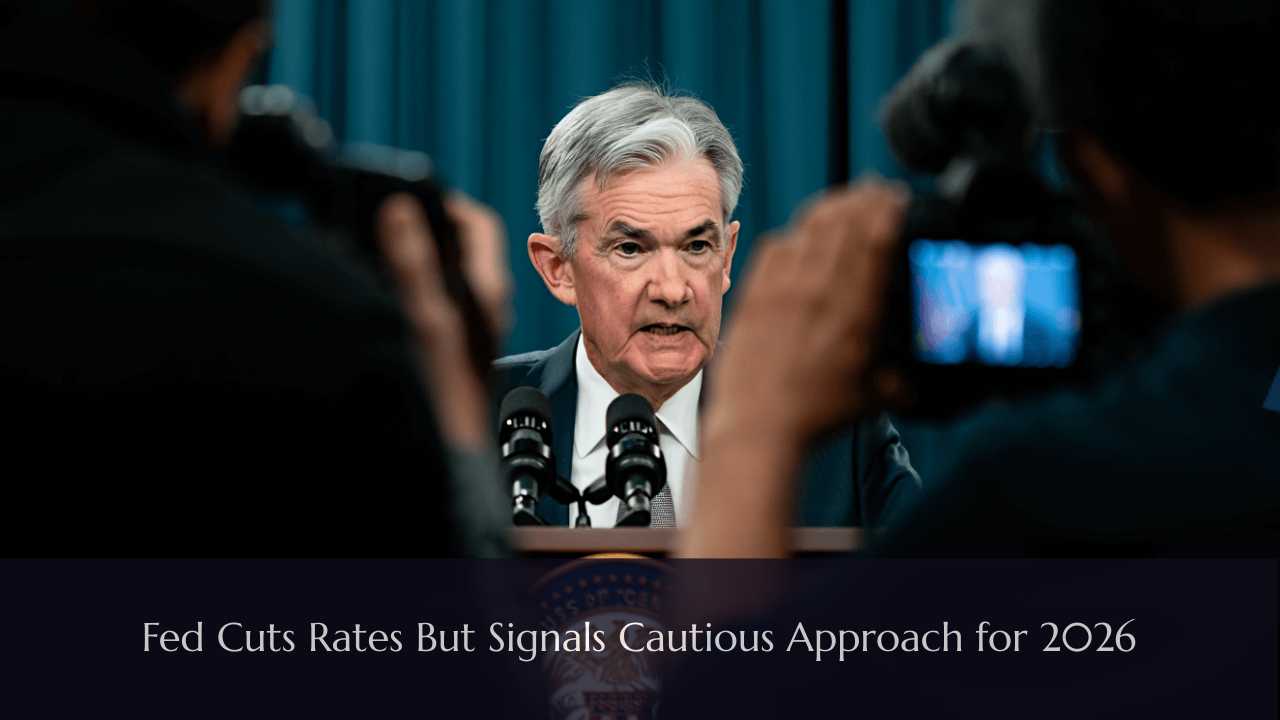
WASHINGTON — The Federal Reserve delivered a quarter-point interest rate reduction Wednesday but sent a clear message that further cuts are unlikely in the near term, as policymakers navigate conflicting economic signals and deep internal disagreements about the path forward.
Unprecedented Division Among Fed Officials
The central bank’s decision to lower its benchmark rate to a range of 3.50%-3.75% marked an unusual moment of discord, with three policymakers dissenting from the majority position. Chicago Fed President Austan Goolsbee and Kansas City Fed President Jeffrey Schmid advocated for keeping rates unchanged, while Fed Governor Stephen Miran pushed for a more aggressive half-point reduction.
This split reflects the challenging environment facing the Federal Reserve as it attempts to balance multiple competing pressures: a softening labor market, persistent inflation above the 2% target, and an economy showing surprising resilience.
Single Rate Cut Projected for 2026
Updated forecasts from Fed officials revealed expectations for just one quarter-point cut throughout 2026, unchanged from September projections. However, the range of individual estimates highlighted stark disagreements about appropriate policy direction, with six policymakers indicating they expect no cuts at all next year, while seven anticipate no additional reductions beyond 2026.
Fed Chair Jerome Powell emphasized during his press conference that the central bank has brought rates down significantly over recent months—175 basis points since last September—and officials now feel positioned to take a wait-and-see approach.
“Having reduced our policy rate by 75 basis points since September and 175 basis points since last September, the fed funds rate is now within a broad range of estimates of its neutral value, and we are well positioned to wait to see how the economy evolves,” Powell stated.
Economic Outlook Remains Optimistic Despite Uncertainty
Despite the cautious stance on future rate cuts, Fed projections painted a relatively positive picture for 2026. Policymakers expect economic growth to accelerate to 2.3%, above the long-term sustainable pace, while inflation moderates to approximately 2.4% by year-end. The unemployment rate is forecast to hold steady at 4.4%, dispelling concerns about potential stagflation that have surfaced periodically this year.
The optimistic economic projections were crafted without complete data following a six-week government shutdown that disrupted regular reporting. Officials relied instead on alternative indicators including internal surveys, community contacts, and private sector data to inform their assessments.
Data Gaps Complicate Policy Decisions
A significant challenge facing the Fed is the lag in official economic data. The most recent unemployment and inflation figures available during Wednesday’s meeting covered only through September, showing the jobless rate at 4.4% and the Fed’s preferred inflation measure at 2.8%—well above the central bank’s 2% target.
The policy statement acknowledged this uncertainty, stating that “in considering the extent and timing of additional adjustments to the target range for the federal funds rate, the committee will carefully assess incoming data.” This language, typically used to signal a pause in policy actions, represents a shift from previous statements and contrasts with market expectations that had been leaning toward two rate cuts in 2026.
November employment and inflation data will be released next week, providing crucial information that could shape the Fed’s stance at its late January meeting.
Market Reaction and Leadership Transition Ahead
Financial markets responded positively to Wednesday’s announcement, with major stock indices closing higher while the dollar weakened and Treasury yields declined. Analysts characterized the move as cautiously accommodative despite the hawkish tone regarding future cuts.
“The 25-basis point rate cut was widely expected and the economic projections remain optimistic. I would view this as a semi-dovish, cautious statement,” noted Peter Cardillo, chief market economist at Spartan Capital Securities.
However, the Fed faces additional complexity ahead with an anticipated leadership change. President Donald Trump is expected to nominate a successor to Powell within the coming weeks, adding another layer of uncertainty to monetary policy deliberations as the central bank heads into a midterm election year.
Rick Rieder, chief investment officer for global fixed income at BlackRock and a reported finalist for the Fed chair position, suggested the central bank would likely remain on hold for an extended period given the lack of consensus, slow data release, and incoming leadership change. However, he noted that continued weakness in labor market indicators could prompt another quarter-point cut as early as January.
Political Pressures and Policy Independence
The Fed’s cautious approach comes as Trump has publicly advocated for more aggressive rate reductions. How monetary policy evolves will depend heavily on incoming economic data, particularly as the nation heads into a midterm election year where economic performance could play a central role.
The central bank’s ability to maintain its independence while navigating these political pressures, incomplete economic data, and internal policy divisions will define its effectiveness in the months ahead as it seeks to achieve its dual mandate of maximum employment and price stability.