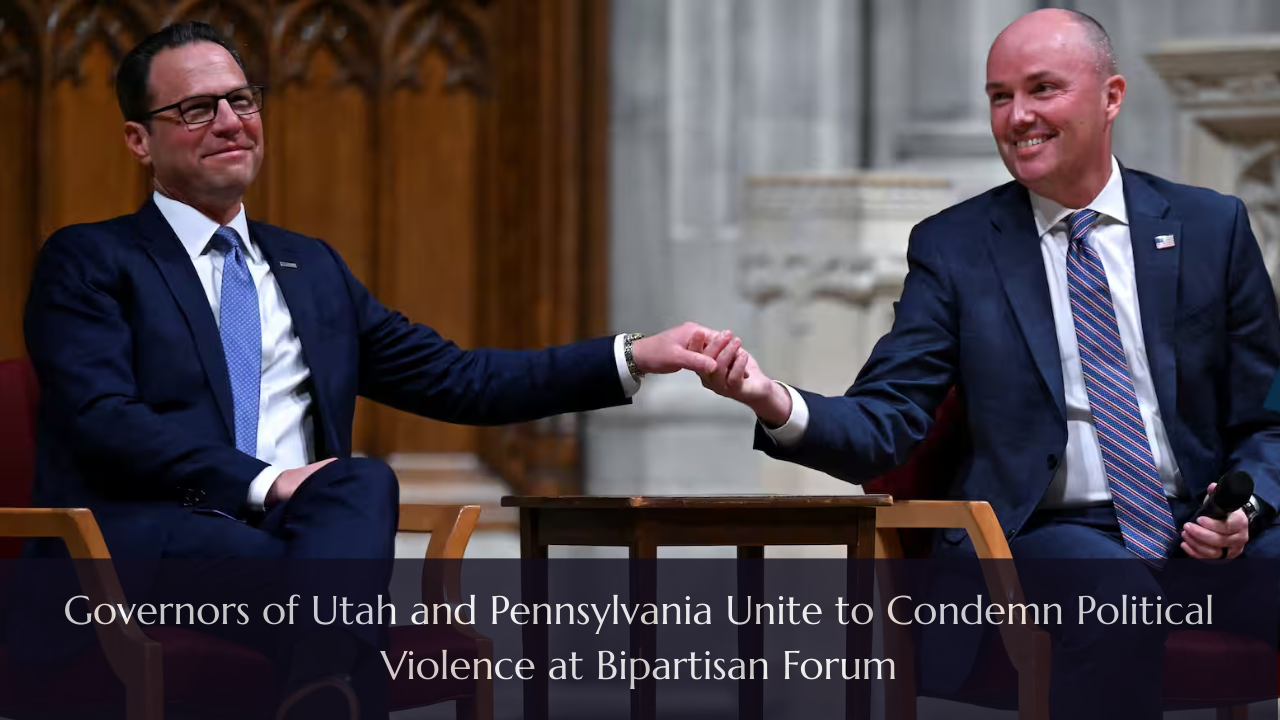
Utah Gov. Spencer Cox and Pennsylvania Gov. Josh Shapiro delivered a clear message in Washington this week: the country must confront rising political violence and rebuild a culture of respectful disagreement. The two governors, representing different parties, appeared together Tuesday at Washington National Cathedral for a nationally watched bipartisan event focused on restoring civility in American politics.
Moderated by Savannah Guthrie of NBC’s Today, the discussion was part of the network’s Finding Common Ground initiative, which highlights efforts to reduce political polarization. Their conversation touched on President Donald Trump’s rhetoric, the emotional toll of political violence, and the challenge of fostering dialogue in a deeply divided climate.
Both leaders have firsthand experience with political violence. Earlier this year, a man broke into Gov. Shapiro’s residence and set it on fire, putting his family in danger. Gov. Cox gained national attention after responding to the deadly shooting of conservative activist Charlie Kirk at Utah Valley University. Their shared experiences shaped the urgency of Tuesday’s message.
Shapiro praised Cox for his role after the tragedy in Utah.
“I saw him lift up not just Utahns, but create an opportunity for a dialogue that we sorely need to get us out of the darkness of political violence,” Shapiro said.
Cox recalled that Shapiro was the first to reach out after the shooting, urging him to speak “with moral clarity.”
“In that moment, we were two Americans who were deeply saddened and struggling,” Cox said. “Even though we disagree on a lot of things, we agree on this.”
Calling for Civil Dialogue in a Divided Nation
During their 45-minute conversation, the governors demonstrated that disagreement does not require hostility. Cox advocated banning social media for minors, a position Shapiro does not share. Yet Cox noted their difference without demonizing the opposing view.
“I didn’t say he’s an evil person because he doesn’t want to ban social media,” Cox said. “That’s the difference.”
However, not everyone in the audience embraced the spirit of civility. Several hecklers disrupted the event and were escorted out, underscoring the difficulty of promoting respectful dialogue.
“This idea that we feel it’s OK to scream and interrupt now — we’ve given a pass to this behavior for far too long,” Cox said.
The conversation also highlighted President Trump’s role in shaping the national tone. Shapiro argued that leaders must condemn political violence consistently. He referenced criticism over Trump’s muted response to the killing of a Democratic lawmaker in Minnesota, as well as remarks at Charlie Kirk’s memorial where the president expressed hatred for his political opponents.
“When you’re a governor or president, you are looked to for moral clarity,” Shapiro said. “We have a president right now who fails that test on a daily basis.”
Cox avoided directly criticizing Trump but did not defend him either.
“I’m not trying to play down his divisive rhetoric,” Cox said. “But if we think that a president or governor alone will change where we are, we’re fooling ourselves.”
A Message Cox Plans to Keep Sharing
Gov. Cox, who endorsed Trump in 2024 after withholding support in prior elections, said he hopes the president hears his message on the importance of disagreeing better. Although he had no planned meeting with Trump on this trip, Cox said the two have spoken many times about restoring constructive dialogue.
“He’s said he’s grateful I’m sharing this message,” Cox said. “And it’s one I’m going to keep sharing.”
Cox launched his Disagree Better initiative in 2023 while chairing the National Governors Association (official website). He believes the movement is gaining traction.
“Everywhere I go, this is what’s on people’s minds,” he said. “The vast majority of Americans hate what’s happening in politics, especially the political violence, and they’re looking for something better.”
But change, he emphasized, depends on millions of individuals choosing to be bridge builders rather than combatants.
“The only way we change is if all of us collectively decide to be peacemakers.”
The event was supported by several organizations, including the Wheatley Institute at Brigham Young University (official website). It was part of a broader series titled A Better Way: Sacred Values for Civic Life, which aims to promote civic virtues such as dignity, respect and honesty — core principles organizers say must guide a healthy democracy.
Randy Hollerith, dean of the cathedral, said the goal is to remind Americans that disagreement is acceptable, but dehumanization is not.
“Dignity and respect are essential values for human culture,” he said. “We must remember it’s OK to disagree, but we don’t need to dehumanize one another.”