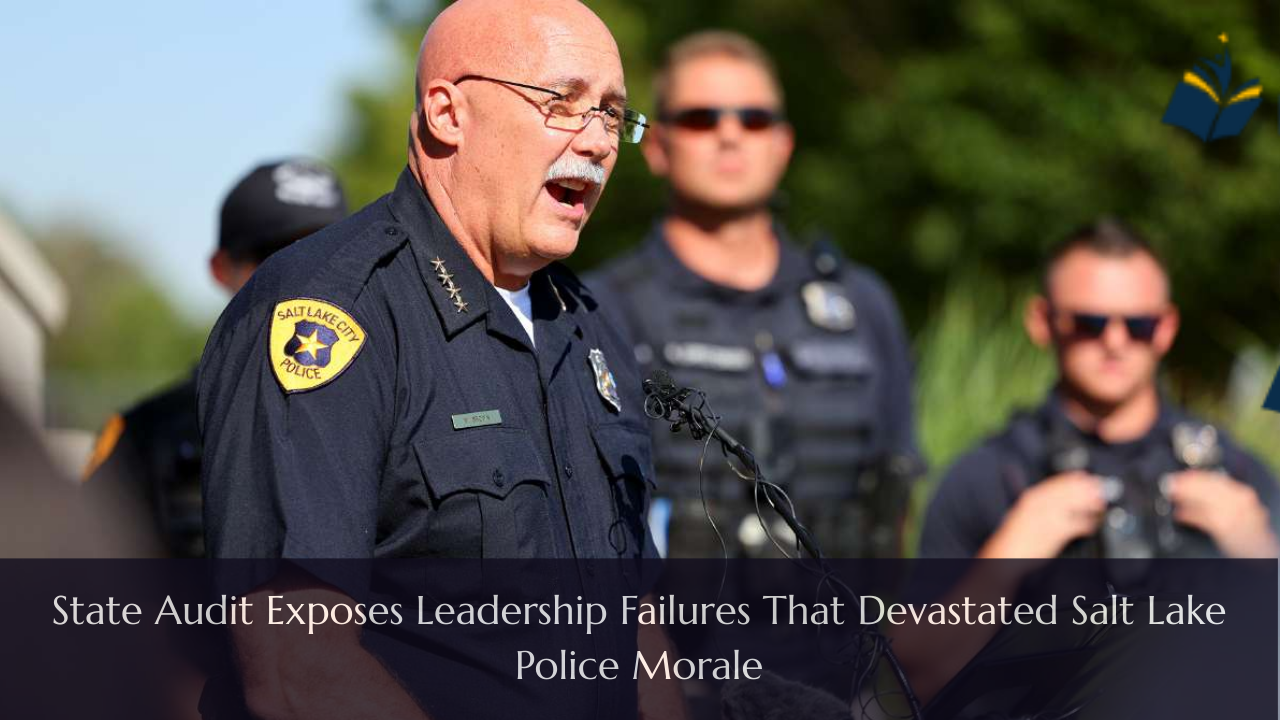
A comprehensive state audit released Tuesday revealed that Salt Lake City Police Department experienced unprecedented morale collapse under former leadership, documenting systematic management failures that drove officers away and undermined departmental effectiveness.
The 48-page report from the Utah Office of the Legislative Auditor General identified multiple practices under former Police Chief Mike Brown that created what auditors described as the lowest morale levels they have ever recorded in any law enforcement culture survey.
Historic Low in Officer Satisfaction
State Auditor General Kade Minchey’s team conducted extensive surveys, interviews and operational reviews to assess the department’s organizational health. Their findings painted a troubling picture of workplace culture that deteriorated significantly in recent years.
When asked whether employee morale was high within their organization, 77 percent of Salt Lake City officers disagreed or strongly disagreed. The result shocked auditors, who had never encountered such negative sentiment in previous law enforcement assessments.
To establish context, investigators administered identical surveys to nearby police departments in Ogden, Sandy and West Valley City. Those agencies reported dramatically different results, with 51 percent to 87 percent of officers agreeing or strongly agreeing that morale remained high within their organizations.
The stark contrast highlighted Salt Lake City’s unique struggles and suggested problems stemmed from internal management practices rather than broader industry challenges affecting all departments.
Administrative Leave Practices Damaged Trust
Auditors identified excessive and unclear administrative leave decisions as a primary factor eroding officer confidence in leadership. Between 2022 and 2024, Salt Lake City placed officers on administrative leave for an average of nearly 90 days—triple Ogden’s average and nearly six times Provo’s duration.
Records reviewed by investigators revealed officers were placed on leave for reasons that appeared unclear and sometimes exceeded policy guidelines. The inconsistent application of discipline created perceptions that decisions were arbitrary rather than based on objective criteria.
One particularly concerning case involved an officer placed on leave for approximately eighteen months during an investigation that ultimately determined allegations were unfounded. Despite being cleared, the officer remained on administrative leave for an additional year without documented justification.
“This is concerning, as other officers reported they believed this case was overtly punitive and intended more to avoid embarrassment than to address substantiated misconduct,” the audit stated, noting that fear of indiscriminate punishment created demoralizing stress.
Officers told investigators they felt afraid to take action because they believed they might face administrative leave without legitimate cause. The mental toll affected decision-making and job performance across the department.
Nearly 80 percent of surveyed officers said they perceived no clear criteria governing decisions related to hiring, promotions or salary increases, further undermining confidence in leadership fairness.
Communication Breakdown Between City Hall and Officers
The audit documented significant communication failures that created confusion about operational priorities and enforcement expectations. A 2021 statement by Salt Lake City Mayor Erin Mendenhall regarding the city’s role in camping ordinance enforcement exemplified these problems.
Mendenhall’s public comments suggested the city should not prioritize enforcing camping laws, but no formal directive reached officers for two years until Brown issued clarifying guidance. The gap left patrol officers uncertain about appropriate responses to illegal camping situations.
Enforcement data revealed the confusion’s impact. Between 2019 and 2024, more than one quarter of all illegal camping citations or arrests occurred during the final two months of 2024—shortly after the audit was ordered and leadership began changing enforcement emphasis.
Officers reported that leadership frequently published goals externally without meaningful internal discussion about implementation strategies or performance expectations. Despite collecting extensive operational data, previous leadership never established processes for translating information into actionable improvements.
Civilian Advisers Gained Outsized Influence
High-ranking officers told auditors that Brown regularly consulted key civilian advisers over senior police leaders when making operational decisions. This practice, which officers attributed to excessive risk aversion, fractured trust within command structure.
Brown delegated substantial authority to human resources personnel, legal counsel and public relations officials who exercised powerful influence over department operations. Senior officers reported being excluded from critical leadership discussions, creating perceptions of poor communication that survey results confirmed.
While civilian expertise provides valuable support, auditors noted that other departments maintain compliance-focused advisory roles that help police make decisions rather than making decisions for them. The distinction proved crucial for maintaining clear command structure and accountability.
Internal Oversight Gaps Compounded Problems
Salt Lake City police disbanded its internal audit function last year, eliminating a mechanism for identifying inefficiencies and monitoring high-risk processes. The department also failed to implement multiple recommendations from previous internal audits, according to investigators.
The absence of systematic internal review contributed to gaps in continuous improvement efforts. Without regular evaluation, problematic patterns persisted and expanded rather than being addressed proactively.
Five officers received three-month suspensions from the Peace Officer Standards and Training Council earlier this year for falsifying timecards. Auditors suggested the misconduct might have been more widespread because prior leadership failed to adequately manage shift risks and supervision.
Turnover Reflected Systemic Dysfunction
Despite increases in police funding during recent years, 282 sworn officers departed the department between 2020 and 2024. The organization maintained approximately 600 total officers, meaning nearly half the force turned over during the five-year period.
The exodus represented significant institutional knowledge loss and created recruiting and training burdens that further strained remaining personnel. High turnover typically signals fundamental organizational problems rather than isolated incidents.
Former Chief Disputes Findings
Brown issued a strong rebuttal after the audit’s release, criticizing investigators for never contacting him directly during the review process. He characterized the lack of opportunity to respond as more revealing than the report’s actual findings.
The former chief pointed to innovative policing strategies that received local and national recognition during his tenure, arguing these demonstrated his commitment to creating safer streets.
“This audit was part of a political attack aimed at the Salt Lake City Police Department under my leadership and, inevitably, Salt Lake City itself,” Brown stated. “It functioned as a vehicle to present a manufactured partisan indictment, not a fair and independent inquiry.”
New Leadership Implements Reforms
Brian Redd, former Utah Department of Corrections director, assumed the police chief position in March after Mendenhall asked Brown to retire amid mounting pressure from state leaders. Auditors expressed encouragement about changes implemented since the transition.
Redd unveiled a new senior leadership team this summer and initiated reforms addressing morale and culture before receiving the audit’s formal findings. New internal communication practices and development of a strategic plan with clear organizational objectives represent priority initiatives.
Mendenhall and Redd submitted a joint response outlining implementation plans for all audit recommendations. These include measures ensuring appropriate and consistent administrative leave use, improved review timeliness, enhanced communication protocols, better timecard supervision, and restored internal audit functions.
The reforms aim for completion within the coming year, with regular progress monitoring to ensure accountability.
State Leaders Acknowledge Progress
Utah legislative leadership, which requested the audit and previously criticized the department’s performance, acknowledged improvement under new management.
Senate President Stuart Adams and House Speaker Mike Schultz, who co-authored a letter demanding public safety improvements last year, expressed confidence in Redd’s leadership and progress addressing crime issues during Tuesday’s audit presentation.
House Majority Leader Casey Snider, who sponsored legislation that could have penalized the city for insufficient cooperation on criminal justice matters, praised the turnaround.
“Chief Redd, you have a hand in that, but Madam Mayor, you deserve that credit,” Snider stated. “There are clearly still problems in Salt Lake, but clearly some of them are not your fault.”
The mayor emphasized ongoing collaboration between city leadership and the police department to address challenges accumulated over recent years.
“We’re going to keep working hand-in-glove as we undo the challenges that this department faced over the years,” Mendenhall said. “The audit has helped provide great clarity for us.”
The path forward requires sustained commitment to implementing recommended reforms while rebuilding trust between officers, command staff and city leadership. Success depends on maintaining accountability mechanisms that prevent future management failures from recreating the conditions that devastated departmental morale.