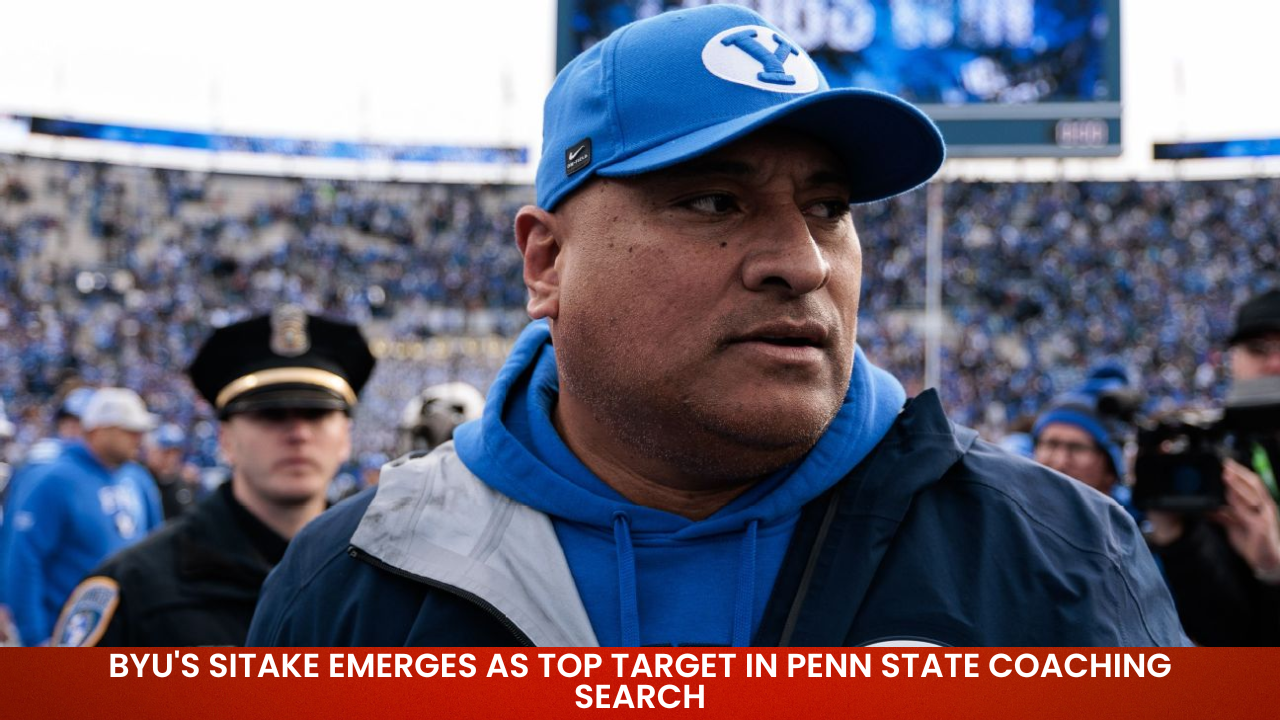
At what should be a pinnacle moment for BYU football, head coach Kalani Sitake finds himself at the center of intense speculation about his future. Just days before leading the Cougars into their most significant game in recent memory, reports indicate that discussions between Sitake and Penn State have intensified as the Nittany Lions search for their next leader.
The timing highlights one of college football’s most problematic issues: the misalignment between championship competitions and coaching market dynamics that forces programs and coaches into impossible situations at critical moments.
A Season of Historic Success Now Clouded by Uncertainty
Sitake has constructed an impressive campaign in 2025, guiding BYU to an 11-1 regular season record and a ranking among the nation’s top programs. The Cougars stand one victory away from claiming the Big 12 championship and securing an automatic berth in the College Football Playoff, accomplishments that seemed unlikely when the program joined the conference just three years ago.
The remarkable success makes Sitake an attractive candidate for programs with greater resources and national prominence. Penn State reportedly would offer compensation well above Sitake’s current salary, which observers believe falls significantly below what comparable coaches at major programs earn.
BYU faces Texas Tech in Saturday’s conference championship game in Arlington, a rematch of the Cougars’ only loss this season. Rather than focusing exclusively on game preparation, the program now navigates questions about whether its architect will remain beyond this week.
The Coaching Calendar Crisis
This situation exemplifies a growing problem across college football. Championship week coincides with early signing day for recruits, creating a compressed period where schools simultaneously compete for titles while managing coaching transitions, staff restructuring and recruiting pressures.
Programs preparing for their most important games face distractions that opponents focused solely on football avoid. The competitive imbalance creates scenarios where success on the field paradoxically becomes a disadvantage in the coaching marketplace.
Recent examples underscore the dysfunction. Lane Kiffin recently accepted the LSU position while Ole Miss pursued a potential playoff appearance, taking much of his offensive staff with him. The Rebels now face the prospect of committee evaluations while operating with a fundamentally altered coaching structure.
Even observers outside college football recognize the absurdity. Basketball coaching legend Rick Pitino questioned the logic of a system where coaches might depart during championship pursuits, asking why anyone would leave a potential title team at the height of competition.
Understanding Sitake’s Position
Sitake operates within a flawed system not of his making. As a professional coach at the highest level of college football, he has responsibilities to evaluate opportunities, negotiate fair market compensation for himself and his staff, and secure resources his players need to compete.
Sitake has maintained transparency with his players throughout the speculation, addressing rumors directly rather than allowing uncertainty to fester. He characterized the attention as a positive sign reflecting the program’s success.
His track record since 2020 demonstrates consistent excellence. Over six seasons, BYU has compiled a 56-19 record, representing a winning percentage of 74.7 percent that ranks seventh among all FBS coaches during that span. The sustained success through conference realignment and multiple roster transitions showcases exceptional program management.
Sitake has previously expressed his desire to build a legacy at BYU comparable to legendary coach LaVell Edwards, under whom he played. However, aspiration toward long-term commitment does not preclude professional evaluation of market opportunities, particularly when substantial resource disparities exist.
Even Edwards, the iconic figure of BYU football, entertained offers and conducted interviews during his tenure. Exploring opportunities represents standard professional practice rather than disloyalty or abandonment of institutional commitment.
The Financial Reality
Determining fair market value for a coach with Sitake’s achievements presents complex questions. Should compensation align with average Big 12 salaries, broader Power Four conference standards, or rates at programs consistently finishing in the top 20 nationally?
According to available data, the average head coaching salary across major conferences hovers around 7.6 million dollars annually. This benchmark provides context for evaluating whether BYU compensates Sitake appropriately given his results.
As a private religious institution, BYU does not publicly disclose coaching salaries or athletic department finances. Various reports estimate Sitake’s current compensation in the three million dollar range plus performance incentives, substantially below what coaches at peer institutions with similar records receive.
Penn State paid James Franklin over 8.5 million dollars per year before his termination, illustrating the compensation gap between programs. The differential represents not merely preference but fundamental capacity to invest in coaching excellence and program infrastructure.
BYU’s Recent Extension and Unresolved Questions
Following the 2024 season, BYU announced a long-term contract extension for Sitake after he earned regional coach of the year recognition. The extension built upon his existing agreement that previously ran through 2027, with BYU’s typical practice limiting contracts to five-year terms.
Critical details remain unknown about the extension’s substance. Whether it included salary increases, expanded staff resources, or enhanced NIL support for players has not been disclosed. The absence of this information fuels speculation about whether BYU adequately addressed Sitake’s compensation and program needs.
Timing questions also emerge. Should BYU have acted more proactively rather than waiting for external pressure? Other successful programs locked in their coaches mid-season to avoid year-end leverage situations.
Indiana announced an eight-year, 93 million dollar contract for Curt Cignetti in October, securing their leader during the season rather than waiting for competing offers to emerge. The contrast highlights different approaches to talent retention.
Comparing Football and Basketball Investment
BYU’s basketball program appears to operate with resources and NIL support comparable to top-25 programs nationally. The university invested heavily in modernizing facilities and staff, producing immediate competitive results.
The basketball program’s success followed substantial financial commitments and strategic infrastructure development. A professional-caliber staff structure has helped attract and retain high-level talent through competitive NIL arrangements.
Kevin Young’s basketball coaching contract reportedly approaches 4.3 million dollars annually over seven years, with a recent extension following a successful first season. The basketball investment creates natural questions about football compensation priorities.
Football generates far more revenue and delivers broader national visibility than basketball at most institutions, including BYU. A logical standard suggests the football coach should earn substantially more than the basketball coach if the program expects to retain coaching talent amid competitive market pressures.
Potential Succession Scenarios
If Sitake departs for Penn State, BYU enters one of its most consequential coaching searches in program history. Several candidates with varying qualifications and BYU connections might emerge as potential successors.
Jay Hill, the current assistant head coach and defensive coordinator, represents internal continuity. His familiarity with the program and existing relationships with players and staff could facilitate a smoother transition than an external hire.
Kelly Poppinga oversees special teams and brings deep BYU ties through his playing career and coaching tenure. Jason Beck, the offensive coordinator, has demonstrated creativity and adaptation while maintaining connections to the program.
Bronco Mendenhall, who previously led BYU before departing for Virginia, currently coaches at Utah State. His return would bring proven success and institutional knowledge, though his previous departure might complicate such discussions.
Kellen Moore, now an NFL head coach with New Orleans, played at Boise State but has BYU family connections. Ken Niumatololo built successful programs over decades but may be nearing the end of his coaching career.
The risk increases if Sitake brings substantial portions of his staff and roster to Penn State. Modern college football sees coaches routinely taking assistants and persuading players to follow them, potentially depleting program infrastructure overnight.
Competing Narratives About Sitake’s Future
Sources close to the situation have provided contradictory accounts of likely outcomes, reflecting genuine uncertainty about how negotiations will resolve. The divergent perspectives underscore that no definitive conclusion has been reached.
One narrative suggests Sitake and BYU administration have reached tentative agreement pending approval from university leadership and governing boards. This scenario would provide Sitake with resources and autonomy to maintain top-25 competitiveness while cementing his role as the program’s long-term leader.
The alternative perspective paints a bleaker picture. Penn State possesses substantial financial resources to attract Sitake through compensation and NIL support that BYU cannot match. This view holds that Sitake’s departure is inevitable once Penn State formalizes its offer.
The uncertainty reflects genuine complexity rather than posturing or gamesmanship. Both scenarios remain plausible depending on BYU’s willingness to significantly increase its investment and Penn State’s determination to secure Sitake regardless of cost.
What Sitake Might Be Seeking
Multiple factors could motivate a potential departure beyond simple salary maximization. Sitake’s competitive nature might drive interest in the challenge of building a national championship contender at a program with elite resources and recruiting advantages.
Financial considerations undeniably matter. Generational wealth that secures his family’s future indefinitely represents a legitimate priority that should not be criticized. Professional coaches have finite windows to maximize earning potential.
However, relationship-oriented coaches like Sitake also value institutional respect and operational autonomy. If he perceives insufficient appreciation or support from BYU leadership, that sentiment could influence his decision as much as financial differentials.
Sitake signed an extension last year and assumed an associate athletic director role within BYU’s department, suggesting the institution values his broader contributions beyond coaching. Whether that appreciation translates into adequate resource commitment remains unclear.
For Sitake, BYU represents more than employment. He played for the program, has repeatedly called it his dream job, and shares the religious affiliation central to the university’s identity. Departing would require overcoming deep personal and professional connections.
The Critical Week Ahead
The coming days will determine whether Sitake remains at BYU or becomes Penn State’s next head coach. Saturday’s championship game provides a final showcase of what he has built in Provo, regardless of whether it concludes his tenure.
BYU’s administration faces pressure to demonstrate commitment to football excellence matching its basketball investments. The situation tests whether the university will compete financially for coaching talent or accept limitations that potentially reduce long-term competitiveness.
For Penn State, securing Sitake would represent a significant coup, acquiring a proven winner with exceptional player development skills and cultural program-building expertise. Questions remain about whether he can recruit effectively in the Northeast, though modern NIL realities may mitigate traditional geographic recruiting disadvantages.
The resolution of this situation carries implications beyond two institutions. It will influence how programs value coaching retention, when coaches feel comfortable entertaining offers, and whether the sport’s calendar dysfunction will be addressed by governing bodies.
As BYU prepares for its championship opportunity, the larger question looms: will success on the field translate into institutional commitment to sustain that success, or will the program’s architect depart for resources unavailable in Provo? The answer matters not just for BYU but for understanding how college football’s economic realities shape competitive outcomes across the sport.