
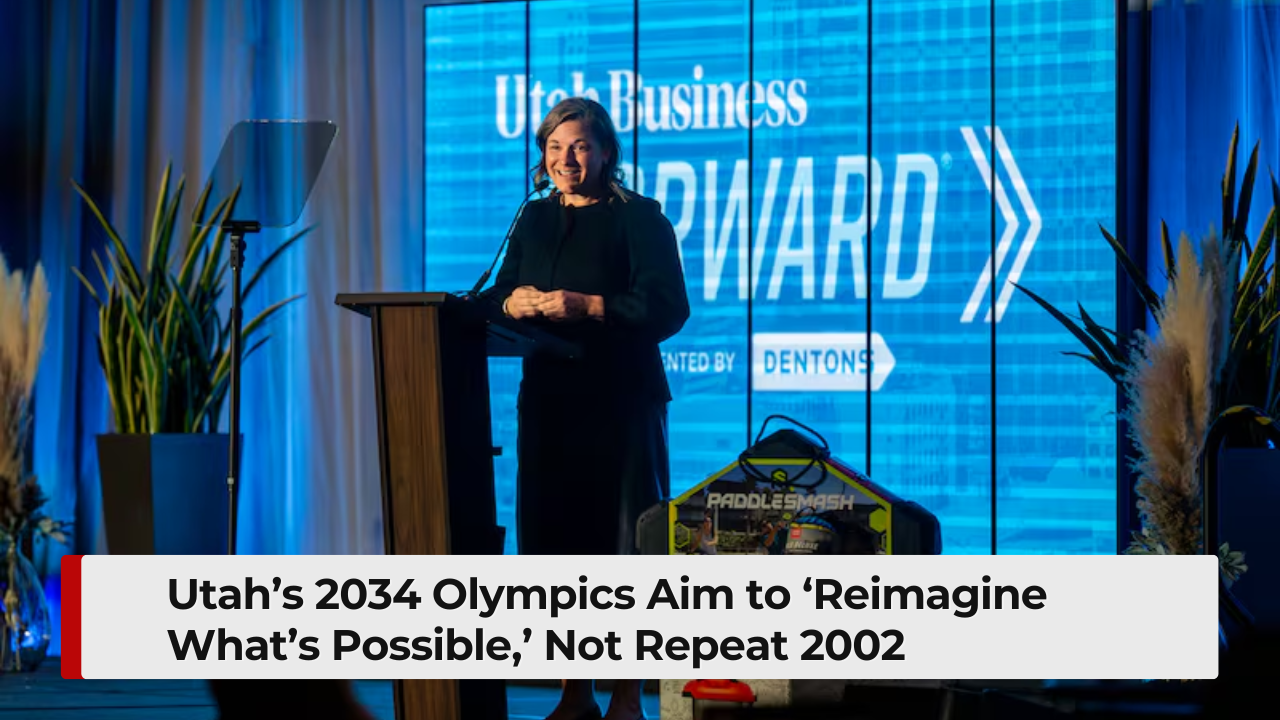
Utah leaders say the 2034 Winter Olympics will not be a replica of the state’s widely praised 2002 Games. Instead, organizers describe the upcoming event as a reimagined model of innovation, purpose and long-term legacy—one already gaining national attention for its unprecedented philanthropic support.
Four-time Olympian Catherine Raney Norman, now vice president of development and athlete relations for the Organizing Committee, told business leaders at the Utah Business Forward Conference that more than $200 million has already been raised through Podium34, a first-of-its-kind philanthropic campaign. These early contributions will support planning for what is expected to be a $4 billion, privately funded Olympic and Paralympic Games. Official preparations are conducted under oversight from the International Olympic Committee.
Raney Norman said the early fundraising effort reflects what makes Utah unique. “We don’t just host events here. We use them as a chance to lift ourselves collectively,” she said. With nearly all competition venues from the 2002 Games still intact, organizers say they can shift from building facilities to maximizing new opportunities, strengthening community programs and accelerating legacy-focused initiatives.
Rather than recreating 2002, she emphasized that the goal is to reimagine what’s possible. Podium34, she said, is already helping transform areas like youth sports, mental health support, arts, culture and volunteer development. These efforts allow Utah to begin shaping its Olympic legacy years before the flame is lit.
Raney Norman shared how her own Olympic dream began when she watched Team USA enter the Opening Ceremony of the 1994 Lillehammer Games on television—a moment she said introduced her to the “fire and passion” that still motivates her work today. That same passion, she said, is found among Utah’s business leaders and philanthropic community supporting the 2034 Games.
The runway between now and 2034 presents major opportunities for local businesses. With the world’s attention shifting back to the United States during the 2028 Los Angeles Summer Games, Utah has a prime chance to strengthen global partnerships, build visibility, and showcase the resilience and innovation that define the state. Raney Norman encouraged companies of all sizes to leverage these years to tell their stories and highlight what sets Utah apart.
As the Games draw closer, organizers expect the energy of the event to influence every corner of Utah’s economy. A study from the University of Utah’s Kem C. Gardner Policy Institute projects a $6.6 billion economic impact, spanning hospitality, tourism, infrastructure, retail and other sectors. But according to Raney Norman, the true value lies in the long-term foundation being built now—a legacy that will support future generations long after the athletes depart.
“We’re creating the runway and the foundation,” she said. “The steady, unseen work that will shape the next generation is happening right now.”