
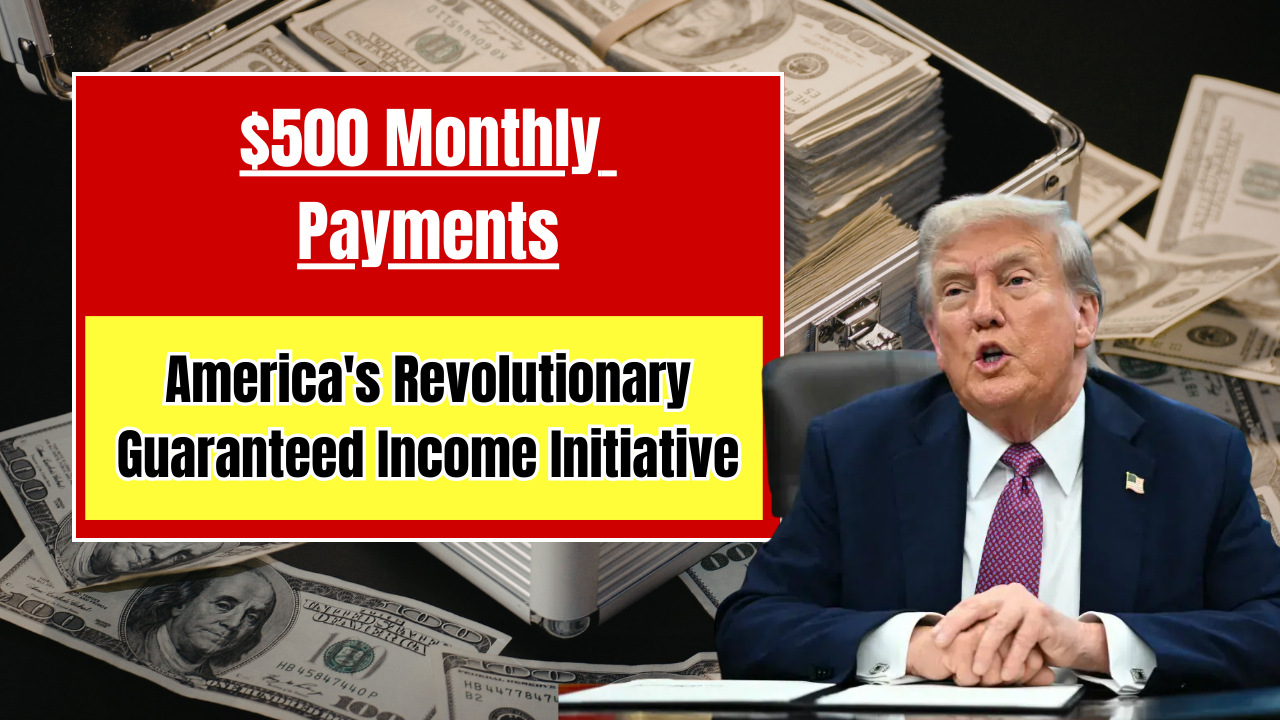
A groundbreaking financial assistance program offering $500 monthly payments to eligible Americans represents a transformative approach to economic security. This unprecedented initiative challenges traditional welfare models by providing unconditional cash assistance, allowing recipients to address their most pressing financial needs without restrictions or oversight.
Understanding America’s First Guaranteed Income Experiment
The $500 Monthly Guaranteed Income Program marks a historic shift in how government addresses poverty and economic instability. Unlike conventional assistance programs requiring extensive documentation and limiting how funds can be spent, this initiative operates on a foundation of trust and autonomy.
Participants receive direct monthly payments they can allocate according to their individual circumstances and priorities. Whether covering rent, purchasing groceries, paying medical bills, or addressing unexpected emergencies, recipients maintain complete discretion over spending decisions.
This design philosophy reflects growing recognition that people experiencing financial hardship understand their needs better than distant bureaucracies. By eliminating paternalistic restrictions, the program acknowledges recipients as capable decision-makers deserving dignity and respect.
Why Monthly Guaranteed Income Generates National Attention
Economic pressures affecting American families have intensified in recent years. Rising housing costs, escalating healthcare expenses, unpredictable employment markets, and persistent inflation create financial stress that traditional assistance programs struggle to address adequately.
The guaranteed income model offers a fundamentally different approach. Rather than fragmenting assistance across multiple programs with varying eligibility requirements and restrictions, it provides straightforward monthly support that families can integrate into their broader financial planning.
Advocates highlight several advantages of this approach. Financial predictability allows better budgeting and planning compared to sporadic emergency assistance. The absence of spending restrictions enables families to address their unique circumstances rather than conforming to predetermined categories. Administrative simplicity reduces bureaucratic overhead while making assistance more accessible.
Research from similar pilot programs nationwide demonstrates promising outcomes. Participants report reduced financial stress, improved mental health, greater ability to pursue education or training, enhanced job search flexibility, and increased capacity to handle unexpected expenses without resorting to predatory lending.
Target Population and Program Objectives
The $500 guaranteed income initiative focuses on individuals and families experiencing economic vulnerability despite employment or other income sources. Many American households earn income insufficient for meeting basic needs, creating persistent financial instability that undermines long-term wellbeing.
Program designers identified three primary eligibility factors determining participant selection. Income level represents the foundational criterion, with priority given to low and moderate-income households falling below specified thresholds. These limits vary by geographic location to account for cost-of-living differences across regions.
Household composition and responsibilities constitute the second consideration. Families supporting children, caring for elderly relatives, or managing disabilities face heightened expenses that strain limited budgets. The program recognizes these realities by considering household size and special circumstances during eligibility assessment.
Economic instability indicators form the third selection criterion. Individuals experiencing irregular work hours, seasonal employment, recent job loss, or other factors creating income uncertainty receive prioritization. This focus ensures assistance reaches those facing the greatest immediate hardship.
These interconnected criteria create a comprehensive eligibility framework targeting households where modest monthly support can generate meaningful impact. Rather than serving only the absolutely destitute or broadly distributing assistance regardless of need, the program strategically directs resources toward families positioned to benefit most substantially.
Program Structure and Payment Mechanics
The guaranteed income initiative employs a streamlined structure designed for accessibility and efficiency. Monthly payment amounts total $500 per eligible participant, representing a substantial supplement to existing household income without replacing employment incentives.
Geographic restrictions limit participation to approved program areas where local governments or organizations have established implementation infrastructure. These regional implementations function as pilot projects generating data about program effectiveness while managing costs during the experimental phase.
Application processes vary by location but generally require basic documentation confirming residency and income status. Unlike traditional welfare programs demanding extensive paperwork and frequent recertification, guaranteed income applications minimize bureaucratic barriers that discourage participation or create administrative burdens.
Participant selection methods differ across implementation sites. Some locations employ random lottery systems among qualified applicants, ensuring fairness when funding limitations prevent serving all eligible households. Other areas use ranking systems prioritizing applicants based on need severity or other factors aligned with program objectives.
This flexibility allows local administrators to adapt implementation to community circumstances while maintaining core program principles. Whether selection occurs through lottery or prioritization, the fundamental commitment remains providing unconditional monthly support to participants.
Financial Stability Through Unrestricted Support
Selected participants receive $500 monthly through direct bank deposit or prepaid debit card, eliminating payment delays and ensuring reliable access to funds. This delivery mechanism provides convenience while maintaining recipient privacy and dignity.
The defining characteristic distinguishing guaranteed income from traditional assistance involves spending autonomy. Recipients face zero restrictions on fund usage and no requirements to document or justify purchases. This unconditional approach rests on several foundational principles.
First, it acknowledges that individuals experiencing financial hardship possess the best understanding of their circumstances and priorities. A single parent might need childcare to maintain employment while another family requires medication or transportation. Allowing recipients to self-determine spending ensures assistance addresses genuine needs rather than administrator assumptions.
Second, eliminating spending restrictions reduces administrative costs and complexity. Traditional programs requiring purchase documentation, vendor approval systems, or category limitations demand substantial bureaucratic infrastructure. Guaranteed income’s simplicity redirects resources from administration to direct assistance.
Third, unconditional support preserves recipient dignity by avoiding surveillance and judgment. Requirements to justify spending decisions or conform to external priorities create demeaning experiences that undermine the assistance’s psychological benefits. Trust-based approaches recognize recipients as competent adults deserving respect.
Common expenditure categories among pilot program participants include essential household needs like groceries and utilities, housing costs including rent or mortgage payments, medical expenses and prescription medications, transportation costs enabling employment, childcare and education expenses, debt reduction to escape predatory lending cycles, and emergency reserves providing financial cushions.
Evidence of Program Impact and Effectiveness
Early results from guaranteed income pilots across multiple states provide encouraging evidence about program effectiveness. Participants consistently report improvements across various wellbeing dimensions extending beyond pure financial metrics.
Financial stability represents the most immediate impact. Regular monthly payments enable better budgeting, reduce reliance on high-interest credit, and create capacity to address unexpected expenses without crisis. Families report decreased anxiety about meeting basic needs and increased ability to plan for the future.
Employment patterns reveal interesting dynamics contradicting critics’ predictions that unconditional income would discourage work. Research demonstrates that guaranteed income often facilitates better employment outcomes by allowing job searches without immediate financial desperation, enabling pursuit of additional training or education, providing flexibility to reject exploitative working conditions, and supporting entrepreneurial ventures requiring startup time.
Mental health improvements represent significant but sometimes overlooked benefits. Financial stress contributes to anxiety, depression, relationship strain, and various stress-related health problems. Relieving this burden through guaranteed income generates wellbeing improvements with long-term implications for individual and family health.
Children in participating households experience positive effects including improved educational outcomes, enhanced nutrition and healthcare access, greater housing stability, and reduced exposure to family conflict related to financial stress. These childhood improvements create lasting impacts extending into adulthood.
Geographic Implementation and Scaling Considerations
Current guaranteed income implementations operate as localized pilot projects rather than national programs. Various cities, counties, and states have launched independent initiatives testing different design elements and targeting various populations.
These distributed experiments serve multiple purposes. They generate evidence about program effectiveness under diverse circumstances, test different administrative approaches and eligibility criteria, build political support by demonstrating tangible results, and manage costs during experimental phases before potential scaling.
Successful pilot programs create momentum for expanded implementation. Communities observing positive outcomes in neighboring jurisdictions may launch their own programs, while state and federal policymakers cite pilot results when advocating for larger initiatives.
However, scaling from pilot projects to comprehensive programs presents substantial challenges. Funding mechanisms sustainable for small pilot populations may prove inadequate for universal coverage. Political opposition from various ideological perspectives creates barriers to expansion. Administrative infrastructure requires development to handle larger participant populations. And questions persist about optimal program design including payment amounts, eligibility criteria, and program duration.
Political Landscape and Policy Debates
Guaranteed income initiatives generate intense political debate reflecting fundamental disagreements about government’s role in addressing poverty and economic security. Supporters and critics offer competing visions grounded in different values and assumptions about human behavior.
Advocates emphasize several arguments supporting guaranteed income expansion. Moral arguments assert that wealthy societies have obligations to ensure basic security for all members. Economic arguments suggest that consumer spending from guaranteed income stimulates local economies. Efficiency arguments note that unconditional cash transfers reduce administrative overhead compared to complex means-tested programs. And freedom arguments highlight how financial security enables meaningful choice about work, education, and family life.
Critics raise various objections to guaranteed income concepts. Fiscal concerns question funding sources and long-term sustainability. Work incentive arguments worry that unconditional income reduces labor force participation. Fairness concerns suggest that providing income to non-workers treats them unjustly compared to working taxpayers. And effectiveness critiques argue that targeted programs addressing specific needs generate better outcomes than general cash assistance.
These competing perspectives ensure ongoing debate about guaranteed income’s merits and appropriate design parameters. The pilot program results will substantially influence these discussions by providing empirical evidence either supporting or challenging various theoretical claims.
Economic Theory and Guaranteed Income Models
The guaranteed income concept draws on various economic and philosophical traditions. Universal Basic Income represents the most ambitious version, providing unconditional cash payments to all citizens regardless of income or employment status. This approach emphasizes simplicity and eliminates means-testing stigma while requiring substantial funding.
Negative Income Tax models provide payments to individuals below specified income thresholds, with payment amounts declining as earnings increase. This approach targets assistance toward lower-income households while maintaining some work incentives through gradual benefit phase-outs.
Guaranteed minimum income programs ensure all households achieve specified income floors through government supplements. This model focuses on poverty elimination while potentially allowing varied implementation approaches.
The $500 monthly program incorporates elements from multiple models while reflecting practical constraints of pilot implementations. Targeting low and moderate-income households rather than universal coverage manages costs while focusing assistance on populations experiencing greatest need.
Future Trajectory and Policy Evolution
The guaranteed income movement’s future trajectory depends substantially on pilot program results and broader political developments. Several potential scenarios could emerge over coming years.
Successful pilot outcomes demonstrating clear benefits with manageable costs could catalyze expanded implementation. More jurisdictions might launch programs, gradually creating broader coverage. State governments could develop comprehensive guaranteed income systems. Federal policymakers might eventually establish national programs building on successful local models.
Alternatively, disappointing results or political opposition could stall momentum. Programs might be discontinued if outcomes fail to justify costs or if political coalitions supporting them fracture. The movement might persist at local levels without achieving broader scaling.
Most likely, guaranteed income will continue evolving through incremental experimentation and adaptation. Different jurisdictions will test varied approaches, generating evidence about optimal design parameters. Successful elements will spread while unsuccessful features are abandoned or modified.
This evolutionary process reflects how social policy typically develops in federal systems. States and localities function as laboratories of democracy, testing innovations that sometimes achieve broader adoption. The current guaranteed income pilot phase fits this pattern, with ultimate outcomes remaining uncertain but possibilities significant.
Implications for Traditional Welfare Programs
Guaranteed income initiatives raise important questions about relationships between new models and existing assistance programs. Several approaches to integration exist, each with distinct implications.
Supplemental models add guaranteed income alongside existing programs like food assistance, housing subsidies, and healthcare coverage. This approach maximizes support for participating households but maintains system complexity and administrative costs.
Replacement models substitute guaranteed income for some or all existing programs, arguing that cash assistance provides greater flexibility and efficiency. However, this approach raises concerns about whether cash payments adequately address specialized needs like healthcare that existing programs target.
Hybrid approaches combine elements of both models, perhaps replacing some programs while maintaining others addressing specific needs that cash alone might not adequately meet. This middle path attempts balancing simplicity with comprehensive support.
The $500 monthly program currently operates supplementally, providing additional assistance without replacing existing programs. This cautious approach allows evaluation of guaranteed income benefits without dismantling established support systems. Future policy decisions about program relationships will depend substantially on pilot results and political considerations.
Path Forward and Key Considerations
As guaranteed income pilots continue generating data and experience, several key questions will shape policy evolution. Optimal payment amounts remain uncertain, with $500 monthly representing one possibility among many. Research must determine what levels generate meaningful impact while maintaining fiscal sustainability.
Duration questions persist about whether guaranteed income should be permanent, time-limited, or some combination. Different durations create different incentives and serve different purposes, requiring careful consideration of program objectives.
Eligibility criteria demand ongoing refinement balancing targeting effectiveness with administrative simplicity and fairness perceptions. Overly restrictive criteria might exclude deserving recipients while excessively broad eligibility strains budgets and dilutes impacts.
Funding mechanisms require development ensuring sustainable revenue sources without excessive economic distortion. Various options exist including progressive taxation, wealth taxes, carbon taxes, or reallocation from existing programs, each with distinct advantages and challenges.
These complex design questions lack obvious answers, requiring empirical evidence, careful analysis, and democratic deliberation. The current pilot phase provides crucial opportunities to gather evidence informing future decisions.
The $500 Monthly Guaranteed Income Program represents more than immediate financial assistance for participating families. It embodies a bold experiment in reimagining economic security for the 21st century, testing whether unconditional cash support can effectively address poverty and instability while respecting recipient dignity and autonomy.
Early indications suggest promise, but definitive conclusions require sustained evaluation across diverse contexts. Whether this initiative becomes a transformative policy innovation or a footnote in welfare history depends on results still emerging and political choices yet to be made.
What remains clear is that economic insecurity affects millions of American families despite decades of traditional assistance programs. New approaches deserve serious consideration, and guaranteed income offers a compelling alternative model worthy of rigorous testing and honest evaluation.